
Transforming rural health in Virginia: A community-driven path toward stronger, more connected care
Rural communities across Virginia face longstanding challenges in accessing health care, from long travel distances to the nearest provider to shortages in primary and specialty care. These challenges are compounded by higher poverty rates, limited broadband access and barriers to preventive and behavioral health services. Roughly 2 million Virginians live in rural areas, experiencing disproportionate health gaps that require coordinated, community-informed solutions.1
To address these gaps, the Commonwealth launched the Rural Health Care Transformation initiative, a statewide effort to strengthen the delivery of health care across rural communities. Guided by direct community input and supported by up to $1 billion in potential federal funding, the initiative aims to reimagine how care is planned, funded and delivered across rural Virginia. Representatives from UnitedHealthcare Community Plan of Virginia attended the state’s listening sessions to support the process, hear from residents firsthand and work with state collaborators on solutions that improve access for all Virginians.
Listening to communities across Virginia
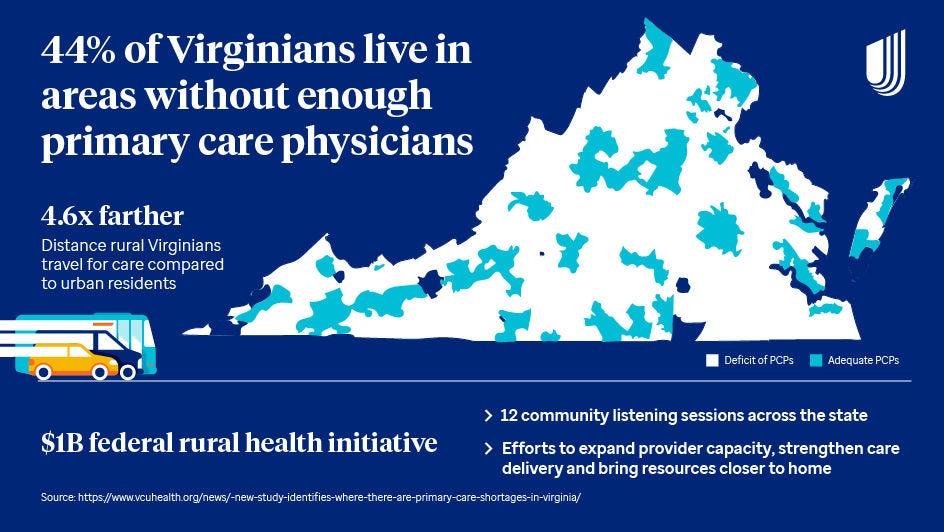
At the heart of this work is a simple but powerful principle: lasting change starts with listening. The state hosted 12 listening sessions across diverse rural regions, engaging more than 400 participants, including hospitals, EMS teams, physicians, clinics, advocacy organizations, food banks and county representatives.
Across these sessions, residents shared their lived experiences and challenges, identifying recurring themes that are shaping the state’s strategy:
- Healthy lifestyle barriers: food insecurity, limited access to nutritious foods and gaps in preventive care
- Access to services: shortages of primary care, dental, emergency and specialty providers; long travel times; and fewer local resources
- Workforce shortages: particularly among OB/GYNs, dentists, behavioral health practitioners and nurses
- Infrastructure and technology: outdated facilities, limited broadband and insufficient modern health technology
- Community collaborations: a strong call for deeper collaboration between providers and community organizations
- Dignity and respect: a need for rural residents and providers to feel respected and valued within the broader health system
This feedback is guiding the state’s strategy, helping to guarantee that policies and programs reflect the lived experiences of rural Virginians. UnitedHealthcare Community Plan of Virginia’s participation highlights its commitment to uplifting community voices and contributing to solutions that support more accessible, sustainable care across the Commonwealth.
Key rural health challenges
Narrative findings from the state’s planning process highlight the urgency of strengthening rural health care infrastructure. Maternal health challenges remain particularly acute, with 22% of rural Virginians driving more than 40 minutes to reach a labor and delivery unit. In five counties, the travel time exceeds 75 minutes. 63% of Virginia counties have no OB/GYN services, while rates of inadequate prenatal care and infant mortality outpace national averages. Additionally, neonatal abstinence syndrome rates are 39% higher than the U.S. average.
Behavioral health gaps are similarly pressing. Rural communities experience high rates of substance use disorder among adults and youth, yet in 2022, more than a quarter of rural counties had no behavioral health prescribing practitioners. While ongoing initiatives like “Right Help, Right Now” aim to expand access, significant needs remain. Workforce shortages extend across the rural health system: nearly 55% of rural localities are designated Primary Care Health Professional Shortage Areas, and rural Virginia has 40% fewer dentists per capita than non-rural areas. Shortages persist among nurses, radiology technicians and other allied health professionals.
Access to care is further strained by fewer primary care providers per capita, long distances for specialty and emergency services and persistent transportation and broadband barriers. These challenges contribute to a higher burden of chronic disease, with rural Virginians experiencing elevated rates of diabetes, obesity, hypertension and high cholesterol compared to rural counties nationwide.
Building a stronger system of care
Virginia’s initiative represents a significant effort to align state, federal and local resources to address rural health challenges at scale. Under Governor Glenn Youngkin’s Executive Directive Twelve, the initiative could unlock up to $1 billion in federal funding authorized through H.R. 1. This investment would help expand access to high-quality, affordable care across rural regions; strengthen provider capacity while supporting the sustainability of rural hospitals; and improve care delivery and outcomes through innovation, collaboration and locally embedded solutions.
Importantly, the state is building on existing momentum. Early pilots, including one led by UnitedHealthcare Community Plan of Virginia, have demonstrated success in connecting high-risk patients to dietitians and tailored meal supports, offering early models for scalable approaches under managed care organization “in lieu of services” mechanisms.
Innovation through collaboration
What makes this initiative especially transformative is its collaborative design. Rather than working in silos, the state is bringing together managed care organizations, local providers, community advocates and health systems to co-design a stronger and more connected rural health ecosystem.
This multi-sector collaboration aligns with the principles of managed care: coordinating services, reducing fragmentation and improving outcomes through holistic supports and preventive care. UnitedHealthcare Community Plan of Virginia remains engaged as a collaborator in this work, supporting the state’s vision of whole-person, community-centered care.
What’s next: Milestones ahead
The Rural Health Care Transformation initiative is already moving forward with several planned milestones:
- Funding application submission: The Cooperative Agreement Funding Application is being submitted as part of the CMS Rural Health Transformation Program
- Hiring & launch (2026): DMAS aims to hire core team staff in early 2026, with senior roles filled shortly after award
- Program launch: Implementation support contractors will help launch programs as close to January 1, 2026 as possible
- Phased implementation: Year One will prioritize ready-to-launch programs, while others will be designed and introduced over subsequent years
- Ongoing engagement: The state will host regional updates and listening sessions twice a year in each of the six rural regions
- Long-term evaluation: Program evaluation and support for subrecipients will continue through 2031
A healthier future for rural communities
Virginia’s Rural Health Care Transformation initiative marks a defining moment in how the state approaches rural health. By listening first, collaborating across sectors and aligning state and federal efforts, Virginia is charting a course toward a more connected and sustainable health system. UnitedHealthcare Community Plan of Virginia is proud to support this work and remains committed to helping build healthier futures for rural residents across the Commonwealth.
Learn more about how we impact our Virginian members by visiting our Virginia profile page.
Enjoy this article? Get future Community & State insights delivered right to your inbox.