
PRIME: driving better health through value-based care in Colorado

At Rocky Mountain Health Plans, we’re working to make health care better and more accessible for our communities. Our focus is delivering equitable, high-quality care that improves outcomes and reduces costs. PRIME, our Payment Reform Initiative for Medicaid Enrollees, is a fully capitated managed care innovation program designed to put these ideas into action.
PRIME supports the physical health of Health First Colorado members in nine counties. PRIME was statutorily authorized in 2012 to address the complex root causes of rising health care costs and to shift the culture of care to focus on whole-person health. In collaboration with local providers and state leaders, we worked to develop a more accountable and transparent health system by:
- Improving member experience through coordinated, person-centered care
- Enhancing reimbursement for primary care providers
- Integrating behavioral health in primary care settings
- Strengthening health infrastructure
- Expanding access to care in rural areas
PRIME works by bringing health systems, safety-net providers, and community organizations together to deliver member-centered whole-person care. It builds on community strengths to integrate care and resources to meet local needs.
Aligning incentives across the health system
PRIME operates under a per-member, per-month (PMPM) capitation model, where RMHP receives a fixed monthly payment to meet our members’ health needs. RMHP contracts with a broad network of independent providers – many in rural areas – including primary care practices (PCMPs) and specialists, to deliver comprehensive, coordinated care to patients.
PRIME redirects resources to primary care – focusing on the parts of the health system that promote preventive care. It operates with a tiered system of payments to incentivize higher standards of quality, access to care, and integration. Through PRIME Global Pay, participating providers are eligible to participate in shared savings based on quality and cost performance. This approach relies on deep collaboration between RMHP, providers, and health systems, creating shared accountability for driving better health in the community.
Payments to providers exceed both the state Medicaid fee schedule and fee-for-service rates. For providers caring for people in rural areas, enhanced funding and coaching support from PRIME help support sustainability in underserved communities. PRIME also supports specialist care by offering enhanced reimbursement, which keeps services like rheumatology available locally and reduces reliance on unnecessary emergency department visits, helping more members receive the care they need closer to home. Hear from Dr. Joe Adragna, a provider based in Montrose, about the impact of PRIME in his community.

Provider perspective: how PRIME drives better access to care
“The best way to deliver value in whole-person health care is through primary care. PRIME allows us to drive the value proposition because it aligns incentives with health care providers, payers, and patients.
In 2019, our Individual Practice Association analyzed the impact of having PRIME in our community. What the IPA found was that PRIME drove two additional FTEs (full-time equivalent) in primary care providers in our community that we likely would not have if we didn't have the PRIME program. That was a big eye-opener for us, and it was a really strong message to me that PRIME was good for our community.
Making PRIME the delivery mechanism in a community drives better access, aligns incentives, and decreases total cost of care.”
Measuring performance and impact
PRIME’s success is measured by a comprehensive set of metrics including cost savings, member experience, and quality scores. In its first year, PRIME came in $18 million under budget – retaining $5 million in shared savings, 90% of which went directly to providers – and returning the remaining savings to the State. PRIME’s budget-neutrality requirement mandates at least 2% annual cost savings, which RMHP has exceeded for four consecutive years, representing over $54 million in taxpayer savings. Over the past decade, RMHP has reinvested more than $29.5 million in Colorado’s health care system through PRIME.
This year, PRIME exceeded many benchmarks established by the Colorado Department of Health Care Policy and Financing (HCPF), including screening for depression, engagement in treatment for alcohol or drug dependence treatment, diabetes A1c control, and timeliness of prenatal and postpartum care.
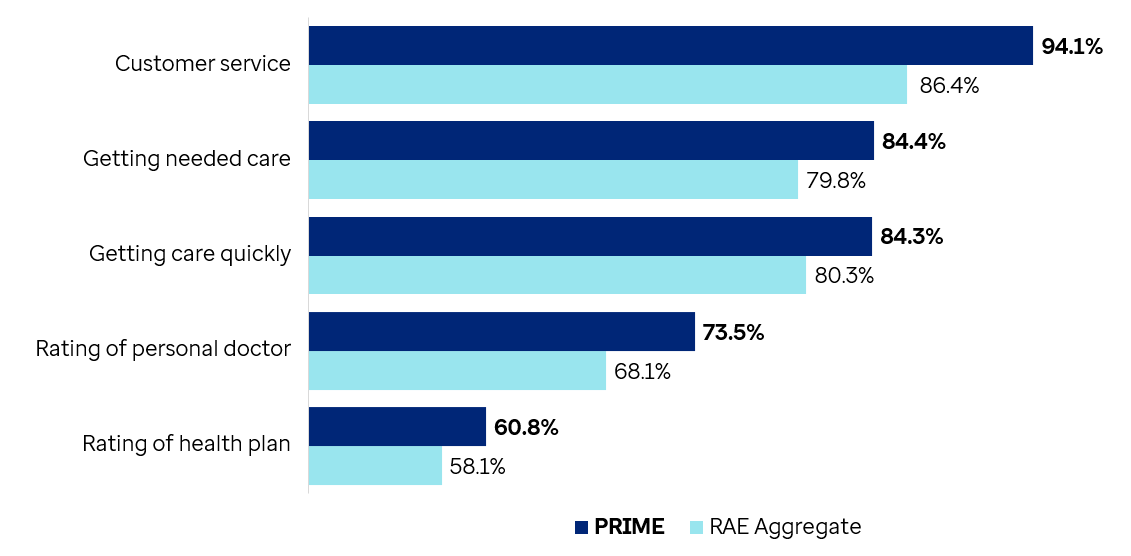
In the 2024-2025 CAHPS survey1, PRIME outperformed Medicaid Regional Accountable Entities (RAEs) in key member experience metrics:
Driving better health together
PRIME demonstrates how collaboration and innovation can transform the health system to work better for everyone. The program has generated measurable improvements in quality of care, member experiences, and cost savings while reinvesting in local providers and community organizations. PRIME aims to shift the focus to person-centered care and to empower providers with a sustainable, integrated value-based care model. Together with providers and communities, RMHP is building a stronger, more equitable health system that puts people first.